
2023 TBF Preventative Research Grant - in honor of Brittany Mccarthy
2023 TBF Preventative Research Grant - in honor of Brittany Mccarthy |
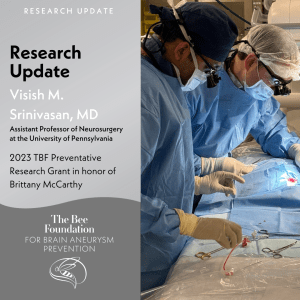
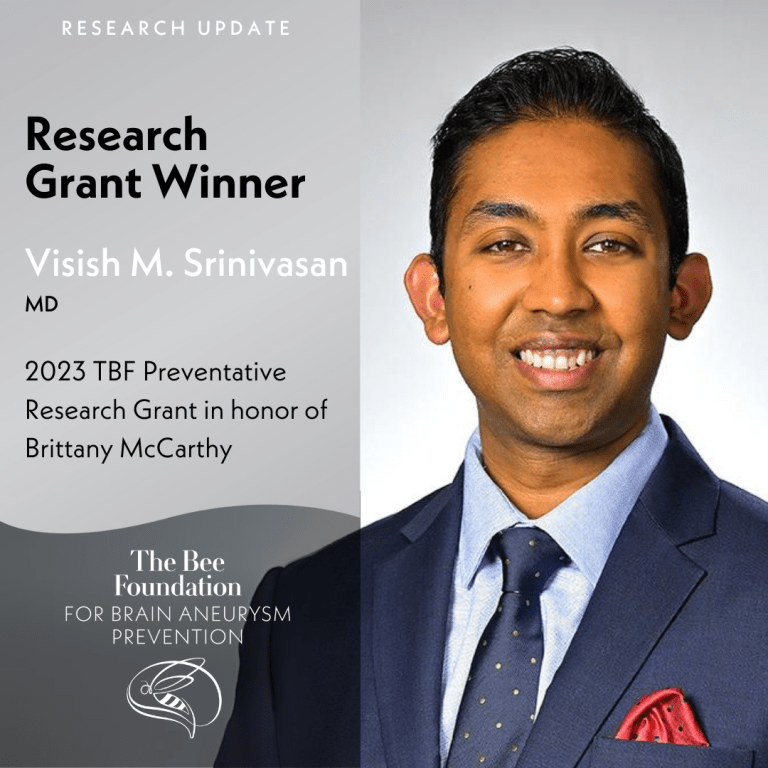
The Bee Foundation awards the Brittany McCarthy Preventative Brain Aneurysm Research Grant to Visish M. Srinivasan, M.D., Assistant Professor of Neurosurgery at the University of Pennsylvania. Brittany McCarthy, a vibrant 21 year old who passed away from a ruptured brain aneurysm in October of 2021. Patricia McCarthy, Brittany’s mother shared “the McCarthy family is honored to be part of this research grant. Brittany’s dream in life was to help others. She was studying to be a Physician’s Assistant and her passion was science and research. This grant is helping to live her dream. It is our hope that this research will help spare other families the tragedy of losing a cherished loved one to this devastating disease.”
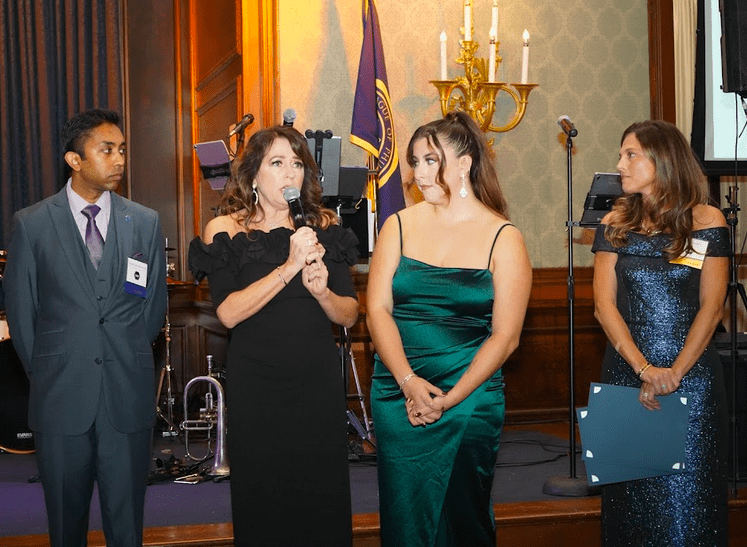
Visish Srinivasan, currently a peer in the cerebrovascular practice at the University of Pennsylvania, has built his career with some of the leaders in the field, with Fellowships in microsurgery and endovascular and extensive work exploring aneurysm creation and treatment devices under his belt. Erin Kreszl, TBF Executive Director , and Christine Kondra, TBF Director of Strategy, recently interviewed him about his current study, which was among the three TBF grants awarded in 2023 for research into innovative approaches to brain aneurysm detection, prevention and treatment.
READ THE INTERVIEW WITH ERIN, CHRISTINE, AND VISISH:
Erin: You obviously have amassed a lot of credits as a neurosurgeon. What drives you as a researcher?
Visish: I often like to say that the point of my role as a researcher is to put myself, as a clinician, out of business! Sure, it is satisfying to be able to treat individual patients and I enjoy getting involved in the nitty gritty clinical side concerning nuances of treatments – really, that’s many surgeons go into the field – that’s basically a short term solution. I find it a lot more rewarding to look at the longer term view, to get to the root of the problem, where you can have a larger impact. That means research, essentially taking bigger shots that have the potential to impact more people. Obviously, the success rate for research is not the same as treating an individual patient, but is has, potentially, a bigger impact. Also, to be honest, being connected to the research side of things is really helpful for me. While it is gratifying when you get patients through their treatments, it can be discouraging to see the continuing stream coming in with ruptures. Knowing there might be better outcomes down the line with more potential for cures and treatments makes that easier and gives me a more positive mindset. At the heart of it all is wanting to get to a basic understanding of how aneurysms form and how they rupture.
Erin: So tell us a little about your research project. The formal title is Defining the Epigenome of Intracranial Wide-Neck Bifurcation Aneurysms, but your research involves epigenetics. Can you put that all into layman’s terms?
Visish: Let’s start with the basic level, the genome. The human genome is the complete assembly of DNA (deoxyribonucleic acid)-about 3 billion base pairs – that makes each individual unique. The epigenome is a group of chemical compounds that tells the genome what to do. So essentially, Epigenetics, as a field, studies the level ABOVE the genome. It involves the changes that occur to the outside of the primary structure of DNA, and reflects how our body reacts to environmental stresses, or diet – those kinds of external factors. The way that DNA is wrapped around the cell affects what areas are exposed and how they are eventually expressed. While epigenetic studies have been performed for other diseases, they have not been for aneurysms.
Erin: So epigenetic studies could help patients whose aneurysms are not, at least immediately, going to be treated, and who are looking to control their risk factors?
Visich: Exactly. We know that aneurysms are not simply only inherited – there is something more to it. We know that other factors play a role, and epigentic issues will cast more light on understanding how those issues would work.
Erin: How is the research going to be conducted?
Visish: We will be using an approach that hopefully will allow us to speed our time to reach conclusions. We’ll be doing that by simultaneously studying both animals (in this case, we will be using rabbits) and human patients. By adding the animal model we can proceed more rapidly as we can test there, and then verify on patients. Essentially, as we go through endovascular procedures, we will be looking at what changes are happening in the rabbit model and then simultaneously taking tissues from patients. That involves taking an endovascular biopsy and running it through some epigentic situations and correlating the two. Hopefully, we will come out with a description of the epigentic changes that are occurring and then scale it up and see where we can make modifications.
Erin: What would be an example of changing epigenetic conditions?
Visish: We know that factors such as diet, or lowering your blood pressure, factor into the equation, but we don’t really understand HOW those factors are affecting the internal environment, how they are changing the aneurysm and aneurysm wall.
Erin: So, what would constitute a good outcome for this study? What would you be looking for?
Visish: Ultimately, we’d like to take this to NIH. From this pilot study we would have an initial description of what epigenetic changes are happening in most aneurysms – we’d have a map of changes that occur in MOST aneurysms (animal and human) and use the epigenetic changes as a signature for aneurysm formation. That would provide some baseline data to enable us to pursue a longer term NIH grant –scaling it up, getting more patient samples and using parallel studies to help us better understand what is changing the gene expression. That opens up some therapeutic options but that’s not the focus of our study – there are others that are looking at the direct delivery – targeted therapy side – and then we can merge our findings to come up with some more directive results – a way to intervene based on our discoveries. But we are probably about at least 5 years away from that goal!
Erin: Interesting you mention NIH as that’s obviously where most of the big-impact research is conducted. It’s what drives our strategy of keeping the long-range view in mind when we identify grants to fund. We want to be able to kickstart that process.
Visish: Absolutely. Something important about NIH –when they fund something, they like to see at least some initial signals as to what a study is going to find, something with enough of a track record that they can be reasonably confident it is going to produce results. Put another way, they like to be series B investors, not the guys who fund the inventor in the garage. And that’s the huge benefit of the grants that you provide, enabling us to take those initial shots that can be leveraged into larger grants.
Christine: What’s been extremely encouraging to us is that we are now hearing firsthand from NIH that they are seeing a critical mass of research grant requests in the brain aneurysm field solely because of the funding that our organization and others are providing.
Visish: And that’s the only way we’re going to eventually get those big breakthroughs. We appreciate the opportunity to be part of that pipeline!