We’re thrilled at the initial results of our 2023 awarded grants. Together, we are truly building the foundation for industry-changing breakthroughs, through both follow-on grant applications to NIH and an increasing body of knowledge focused on achieving a better understanding of the genetic modifications that lead to brain aneurysm formation and rupture, with the ultimate goal of improving outcomes for patients and families affected by brain aneurysms.
Erin Kreszl, TBF Executive Director
Erin Kreszl, TBF Executive Director, talks with David Altschul and Muhammed Essibayi about their 2023 TBF Yezzi Family Research Grant to understand the mental health impacts on brain aneurysm patients
*Formal Title: Impact of Observation versus Treatment on The Psychiatric and Mental Outcomes of Patients with Unruptured Intracranial Aneurysms
A Little Background
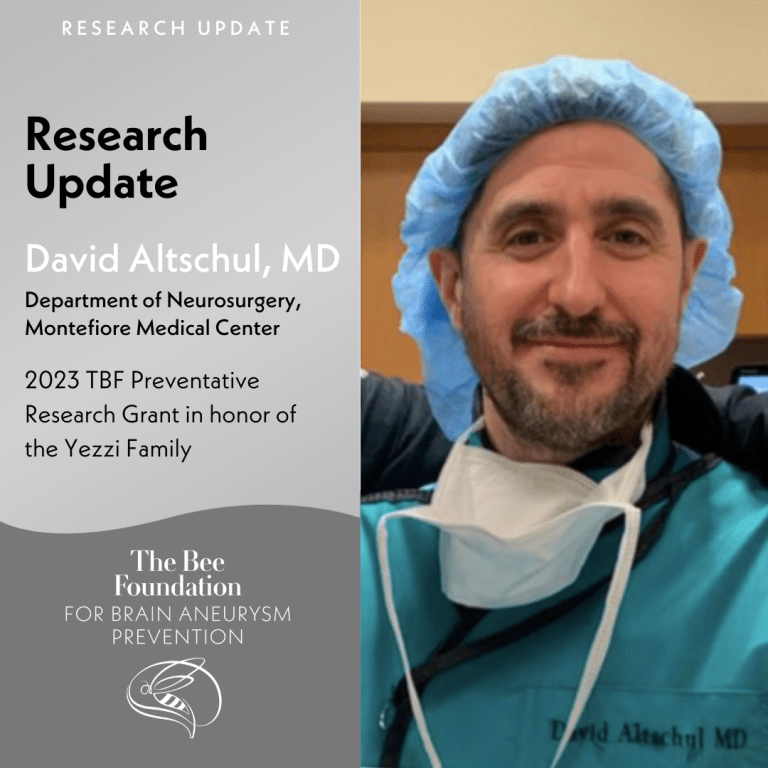
Dr. David Altshul, co-investigator Neil Haranhalli and research fellow, Muhammed Amir Essibayi, was awarded a TBF research grant in 2023 to explore the mental health impacts on patients diagnosed with brain aneurysms.
When determining whether or not to treat an aneurysm once detected, Altschul says, a physician usually follows generally established guidelines focused on eliminating the risk of rupture and bleeding. But should that be the only element that is factored into the decision? With more aneurysms being discovered all the time due to new methods of detection, the question of whether treatment is always the best approach is gaining in criticality. Given the fact that a brain aneurysm diagnosis all by itself is life changing, is the patient going to be better off, or worse, with one decision or the other? Can we create patient centered metrics that reflect these thoughts and feelings? And how do we factor that into the treatment decision?
The Project So Far
Altschul’s goal was to develop a questionnaire that would cover aspects of mental health that had not previously been asked. His team in fact developed related questionnaires covering Anxiety and Depression, Sexual Health, Quality of Life, and concerns about Travel and Accessibility. Questionnaires would be given to a test group of patients with newly discovered aneurysms at followup intervals of 6 month, 1 year and 2 year intervals.
About 40% of their desired patient group of 120 is already enrolled, with a mean age of 58.7 years; 85% are female and 15% male. Most patients (72%) were managed with observation, while 26% underwent endovascular treatment, and 2% had surgical clipping. The team is looking to expand the study to two additional centers in order to increase enrollment rates.
How did our grant advance knowledge in the area of brain aneurysm diagnosis and treatment?
The team’s work is generating a better understanding of the effects of living with brain aneurysms and the impact of treatment decisions.
- New, Standardized Questionnaire. The team produced standardized, proprietary questionnaires that explore mental health and related issues experienced by patients with a brain aneurysm diagnosis. As a result of work with the initial pilot group, the team expanded the questions, including reactions to basic study participation and follow up.
- Clear insights. The questionnaires help to identify barriers – such as logistical issues or emotional concerns – to the mental health of brain aneurysm patients as well as assessing the role of support mechanisms like reminders, flexible scheduling, and counseling services. At the six-month follow-up, data from eight patients (five treated and three observed) showed that endovascular therapy was associated with better outcomes. Patients treated with endovascular therapy had a lower mean baseline anxiety score (7.6) compared to those who did not undergo treatment (9.3). At six months, anxiety scores slightly increased in both groups, while baseline depression scores were lower for those who had undergone endovascular treatment vs. those who had not.
- Platform for ongoing expansion. With the questionnaires in place and initial results coming through, the team will be expanding to additional medical sites both to grow the database and increase patient diversity. An additional interventional neuroradiologist will facilitate the project’s expansion.
- Solid Foundation for Continuing Research. The team is focused on leveraging the findings of this pilot study into a larger NIH research grant. Altschul’s hope is that the research will help to create a standard so that this patient-centered metric is factored into future aneurysm trials.

In a related effort to better improve patient focused studies such as this one, the team will also be conducting a small additional study with a variety of healthcare providers. The interviews will explore areas such as enrollment decisions, best approaches to communication, and challenges with follow up and counseling.