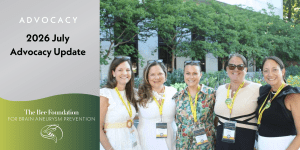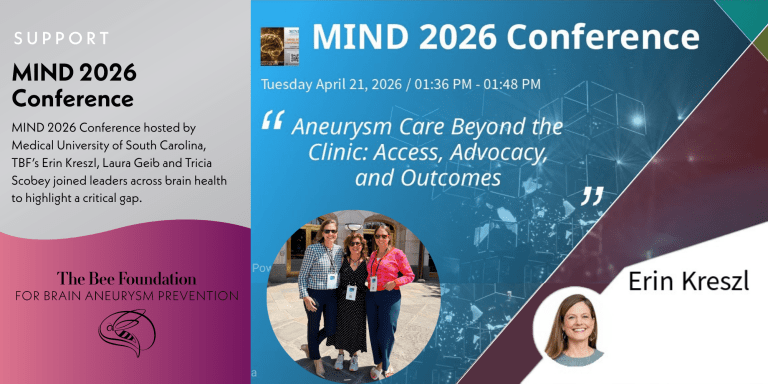
Last week, The Bee Foundation for Brain Aneurysm Prevention had the honor of joining leaders from across the country at the MIND 2026 Conference, hosted by Medical University of South Carolina in Charleston, South Carolina.
MIND 2026 brought together clinicians, researchers, nonprofits, patients, caregivers, and community leaders with a shared goal: advancing brain health through collaboration, innovation, and—most importantly—patient-centered solutions. The conference reinforced something we see every day in our work: meaningful progress happens when care extends beyond hospital walls and into the lived experiences of patients and families.
TBF was proud to be represented by Erin Kreszl, Co-Founder & Executive Director, who spoke during the conference, alongside Laura Geib, Director of Operations & Events, who joined to support and engage with partners across the brain health community.
Expanding Access Beyond the Clinic
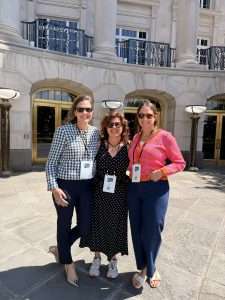
TBF participated in the session Community Brain Health: Expanding Access Beyond the Clinic, where we spoke on Aneurysm Care Beyond the Clinic: Access, Advocacy, and Support.
We were joined by an incredible group of partners all working to improve outcomes across brain health conditions—including traumatic brain injury (TBI), stroke, Alzheimer’s disease, PTSD, and more. Together, we explored what it takes to build systems of care that truly meet patients where they are—not just in moments of crisis, but throughout recovery and beyond.
Our message was clear: for the brain aneurysm community, survival is only the beginning.
Through our Lived Experience Survey, we shared a powerful and consistent theme—there are significant gaps in care after discharge. Survivors are navigating cognitive challenges like memory loss, slowed processing, and difficulty concentrating—often without the resources needed to fully recover.
Even more striking, while only a small percentage of patients receive peer support or recovery education when leaving the hospital, the vast majority say these are the resources they need most.
This disconnect highlights a critical opportunity—and responsibility—for all of us working in brain health.
Centering the Patient Voice
One of the most powerful moments of the conference came during a patient and family panel exploring the question:
How can patients, communities, nonprofits, and academic institutions collaborate to measurably expand access and improve outcomes in brain health?
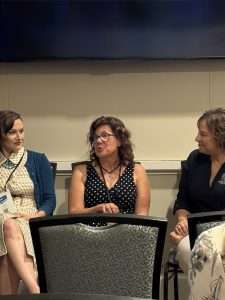
TBF Ambassador Tricia Scobey represented our community with strength and honesty, sharing her experience as a survivor—from the moment of rupture and interaction with first responders to the long road of recovery.
She spoke to the realities survivors face, but also to what’s possible when the right support systems are in place. Through her connection to TBF support groups, Tricia experienced meaningful improvements in her recovery—reinforcing the importance of community, shared experience, and ongoing care.
The panel also included voices from across the brain health community, including a bereaved spouse who lost her husband to Creutzfeldt-Jakob disease (CJD) and a mother whose son sustained a traumatic brain injury in war. Together, these stories underscored a universal truth:
Recovery doesn’t end at discharge—and neither should care.
What We Heard—and What Comes Next
Across every session, one message came through clearly:
We must rethink what recovery looks like—and who is responsible for supporting it.
Survivors are not asking for less clinical care—they are asking for more complete care.
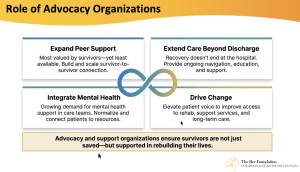
Care that includes:
- Mental health support as a standard part of recovery
- Access to peer support and advocacy resources
- Clear, accessible education on what life after a rupture looks like
- Ongoing connection—not just discharge instructions
At TBF, this is exactly where we are focused—through our Support Hive, Advocacy Day, Awareness Ambassador Program, and continued investment in research that prioritizes prevention and long-term outcomes.
Because advancing brain health isn’t just about saving lives—it’s about improving how those lives are lived.
Join Us
If this resonates with you, we invite you to be part of this movement.
👉 Share this blog to help raise awareness about the realities of brain aneurysm recovery and the urgent need for better support systems.
👉 Reach out to us if you or someone you love has been impacted—we are here to connect you with resources, community, and support.
👉 Get involved—whether through advocacy, events, or sharing your story, your voice matters.
Together, we can ensure that no brain aneurysm survivor—or family—has to navigate this journey alone.