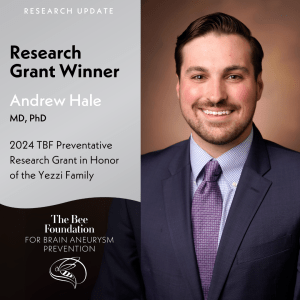
At The Bee Foundation for Brain Aneurysm Prevention, we are committed to funding groundbreaking research that helps prevent brain aneurysms and improve patient outcomes. In a recent interview, Cat Navarro Lee sat down with Dr. Andrew Hale, a neurosurgery resident at the University of Alabama at Birmingham, to discuss his journey in neuroscience, his research on the genetic components of brain aneurysms, and the impact of The Bee Foundation’s grant funding.
A Passion for Neurosurgery and Research
Dr. Hale’s path into neurosurgery began with a deep curiosity about the way blood vessels form. As an undergraduate at Case Western Reserve University, he initially pursued lab research to strengthen his medical school applications but quickly realized his passion for scientific discovery. His research in cardiovascular biology fueled his interest in how blood vessels develop and function, eventually leading him to a combined MD/PhD program at Vanderbilt University.
During his time at Vanderbilt, Dr. Hale pursued a PhD in Biochemistry, further refining his expertise in molecular and genetic research. With the onset of COVID-19 limiting clinical rotations, he took on a postdoctoral fellowship in human genetics, a decision that would later influence his current work in cerebrovascular disease.
The Genetic Puzzle of Brain Aneurysms
Dr. Hale’s research focuses on understanding the genetic factors that contribute to the formation and rupture of brain aneurysms. Many patients and families affected by brain aneurysms often ask the same question: How did this happen? For many, aneurysms remain a medical mystery until they rupture, making early detection and prevention critical.
While previous genetic studies have examined inherited risk factors using blood samples and cheek swabs, Dr. Hale’s work takes a more direct approach. His research investigates the actual cells that make up aneurysms, analyzing their genetic differences from surrounding healthy tissue. By identifying key genetic mutations, his work aims to uncover why some individuals are predisposed to aneurysms while others are not.
“Aneurysms tend to run in families, which suggests a strong genetic component,” Dr. Hale explains. “Our goal is to find that critical genetic variation—like the missing piece of a puzzle—that leads to aneurysm development and rupture.”
A New Frontier: Endoluminal Biopsy
One of the most promising advancements in Dr. Hale’s research is the development of endoluminal biopsy, an emerging technique that allows doctors to gather genetic material directly from inside a blood vessel. By using a specialized coil deployed into an aneurysm, scientists can collect endothelial cells (the cells lining blood vessels) and analyze their genetic makeup.
This innovation could pave the way for personalized aneurysm treatment. Instead of a one-size-fits-all approach, doctors could use genetic information to tailor treatment plans based on the specific characteristics of a patient’s aneurysm.
Bridging the Gap Between Research and Patient Care
For Dr. Hale, the ultimate goal is to translate research findings into clinical practice. “We have reached a point where we understand the key pathways involved in blood vessel formation,” he says. “Now, the challenge is figuring out how to use that knowledge to create better diagnostic tools and treatments.”
While genetic research in aneurysm prevention is still evolving, Dr. Hale envisions a future where hospitals can use genetic testing to identify at-risk individuals early, potentially preventing aneurysms before they occur.
Hope for the Future
Thanks to the generosity of families like the Yezzi family, who funded Dr. Hale’s research grant, progress in aneurysm prevention is accelerating. By supporting research like his, The Bee Foundation helps bring the medical community closer to new diagnostic methods, targeted treatments, and ultimately, a future where fewer lives are lost to brain aneurysms.
As Dr. Hale notes, “We live in an era where scientific advancements are happening rapidly. With continued research, we may soon have new ways to not only detect aneurysms earlier but also develop therapies to prevent them altogether.”
Join the Mission
Supporting brain aneurysm research is crucial to driving these advancements forward. If you’d like to contribute to life-saving research and prevention efforts, consider donating to The Bee Foundation. Every grant we fund brings us closer to a world without the devastating impact of brain aneurysms.