We are honored to announce the recipients of the TBF 2024 Preventative Research Grant Cycle. This year’s grant cycle was very strong prompting J. Mocco, head of the SAB, to comment that only the number of proposals received, but their impressive quality, indicated that TBF was now a true catalyst for the kind of seminal work that could turn into breakthrough research and ultimately major NIH dollars.
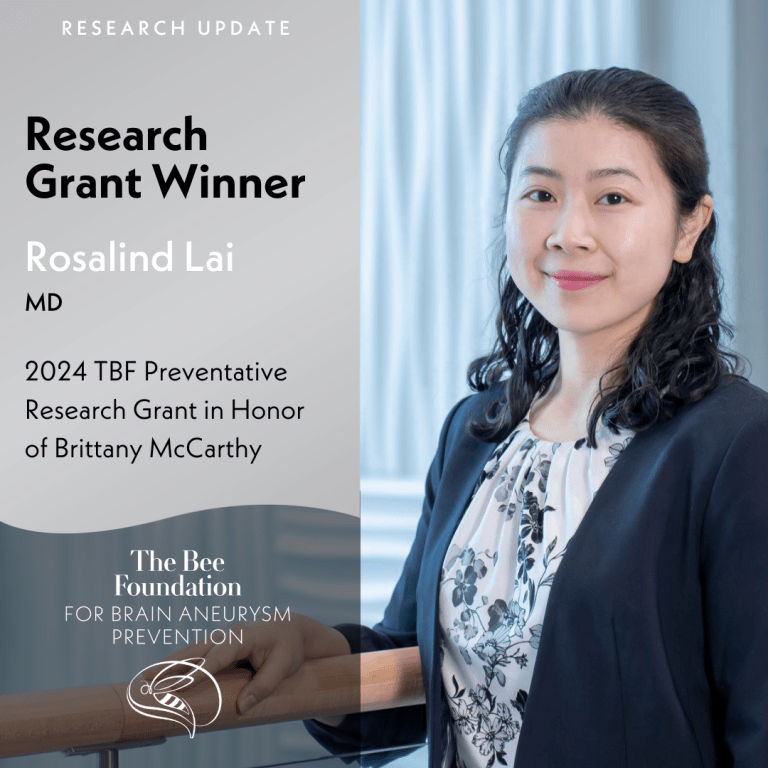
Each of our research grants has been generously supported by a different family who has been touched by brain aneurysm and is dedicated to funding preventative research. This grant has been awarded by the McCarthy Family in honor of Brittany McCarthy, a vibrant 21 year old who passed away from a ruptured brain aneurysm in October of 2021. Led by the loving support of Brittany’s mother, sister, and step-father, Brittany’s community has raised almost $150,000 in support of brain aneurysm research. Brittany’s mother shared “the McCarthy family is honored to be part of this research grant and the two previous grants. Brittany’s dream in life was to help others. She was studying to be a Physician’s Assistant and her passion was science and research. This grant is helping to live her dream. It is our hope that this research will help spare other families the tragedy of losing a cherished loved one to this silent killer.”

Principal Investigator: Rosalind Lai, MD, Assistant Professor in Neurosurgery, Department of Neurosurgery, University at Buffalo, Jacobs School of Medicine and Biomedical Sciences
Grant Title: Investigating the role of X chromosome in the development of cerebral aneurysms through the XO mouse model
Summary:
What We Liked: TBF’s SAB was excited by the research not only because it zeroes in on the higher incidence of IAs in women. a demographic of particular interest to TBF, but because we love innovative approaches and this is one, due to the use of the XO Model, a new approach in this field.
Erin: Welcome! We’re excited to be talking with you today. Before we get into your research project, can you tell us a little about how you got here?
Rosalind: Absolutely. I originally came from Vancouver but I did most of my training in Boston. I attended Wellesley College and afterward completed my MD degree at Harvard. There, I started working with Dr. Rose Du, who has become a real mentor for me in the areas of neurosurgery and aneurysms– in fact, the reason I’m doing what I’m doing today. After graduating, I went to Buffalo where I finished my training and I’ve been incredibly lucky to be able to transition to the faculty there and be working in my capacity as Assistant Professor.
Erin: And your interest in aneurysms has been pretty consistent throughout
Rosalind: It has. I was already looking at understanding the underlying epidemiological risks of aneurysms and, also, the underlying signs of why they develop through my work with Dr. Du.
As far as this particular proposal, its really been fueled not just by my interest in neurosurgery and aneurysms but by my identify as a woman in neurosurgery. We know that women experience more aneurysms than men – particularly post menopausal women – and that their outcomes tend to be worse. We need more, and better, answers as to why.
Erin: One of the things we hope to do when we award a grant is to get our researchers to help us explain their research in layman’s terms, so our supporters can really understand what we’re funding.
Your project summary lays it out pretty clearly! You say:
The proposal aims to investigate the role of X chromosome in the
development of cerebral aneurysms using the XO mouse model. The study’s successful
completion will be the first study to evaluate cerebral aneurysm development in the XO
mouse model, and to potentially identify novel targets on the X chromosome contributing
to the disease.
Can you give us some more background?
Rosalie: Traditionally, the fact that women have a higher rate of developing IA (intracranial aneurysms) has been ascribed to hormonal effects, the presence or absence of estrogen for instance. But we know that’s not the full story. Recent studies suggest that sex-biased diseases result from both chromosomal and hormonal factors and have looked at the role of these factors in various diseases – but we don’t have that information for cerebral aneurysm. We want to close that gap; to understand the role of hormones and chromosomes in development of IAs.
Erin: And specifically, you’re looking at the X chromosome, using mice to do so.
Rosalie: Yes. The X chromosome is increasingly acknowledged as crucial in immunologic and inflammatory regulation. But while the role of X chromosomal genes have been proven to contribute to inflammatory-related diseases, the study of these genes in cerebral aneurysms has been limited. To get a better understanding of the role they do play, we will be using a mouse model. Similar to humans, rodents also exhibit sex differences and female mice demonstrate a higher rate of cerebral aneurysmal development and rupture than male mice, but, as in humans, the underlying mechanism is not well understood.
Erin: Your proposal specifies that you will be using an XO Model. That’s clearly different than the more commonly known XX and XY structures and our SAB was excited that it reflected an innovative approach in this field. Can you explain that a little?
Rosalie: Most people think of males and females as basically being either XX (female) or XY (male.) But the role of the X chromosome is complex, in part due to the impact of male and female hormones. Using the XO Model helps. The XO model, like the XY model, has one X chromosome, and because of that we can better isolate the behavior of that chromosome and evaluate sex-specific differences. While the XO mouse model has been successfully used to study other cerebrovascular diseases, it has not been looked at in conjunction with cerebral aneurysms. Hopefully, through this approach we can prove our hypothesis: that the XO mouse will experience cerebral aneurysmal development similar to the XY (male) mouse as opposed to the XX (female) mouse.
Erin: This could certainly give us some ground breaking new insights about the importance and role of the X chromosome in IAs. . What are the next steps? What can we look for in terms of outcomes?
Rosalie: Well certainly, one outcome is diagnostic. If we can identify these genetic markers we can better predict the likelihood of cerebral aneurysms forming. And this doesn’t mean just between males and females! Even among females, if we can better understand the behavior of these X chromosomal genes we can potentially develop more finely tuned and better diagnostic tools.
The other is therapeutic – If we can identify these genes, we can certainly provide better upfront information and counsel people better, and earlier, as to their options. Further, can we potentially target these genes so people don’t develop these aneurysms or at least have better outcomes? All of these are potentials we would hope to achieve. We’re excited about the potential.