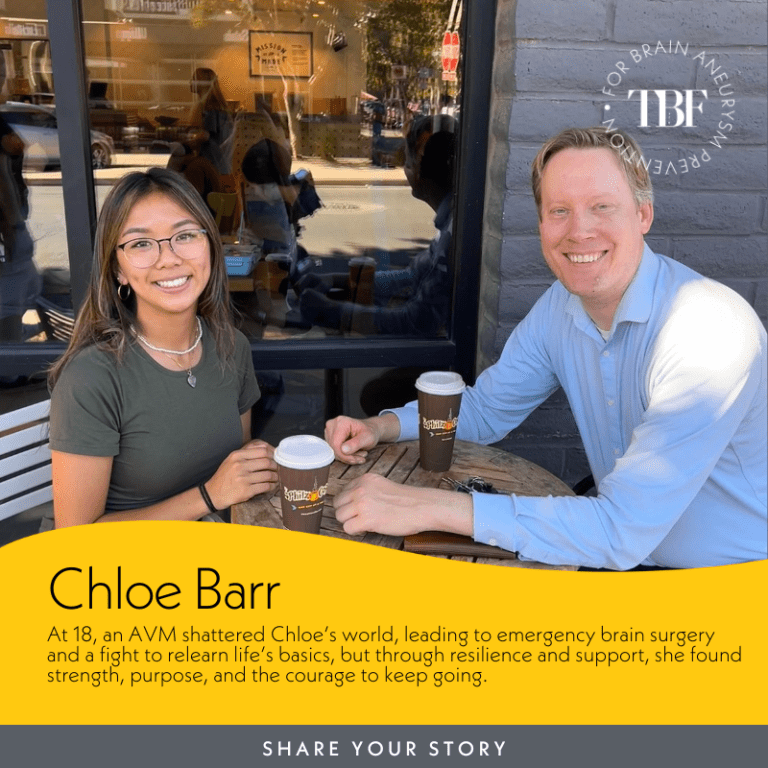
Pictured in Featured Photo: Chloe Barr and Dr. Waldau her brain surgeon.
Turning 18 feels like stepping into a world that’s bigger and louder than you ever imagined—a mix of freedom, excitement, and fear. It’s the age where the world expects you to step into adulthood, ready or not. A few months after entering adulthood, I began preparing to leave for college. Going to college is already a privilege in itself. My experience, similar to many of my peers, started with a roller coaster of emotions. I could see that my parents were excited for me to start my college journey, but I could also sense a bit of hesitation, their only daughter of 5 kids is about to move out..what if something went wrong?
Those questions haunted me too, but I told myself they were just nerves. College is supposed to be the time when you grow, explore, and figure out who you are. It’s a time for plans and possibilities, not fear. But life has a way of reminding you that it doesn’t always follow your plans. What happens when those “what ifs” become “what nows?”
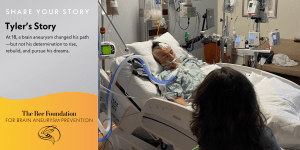
During spring break of my freshman year, the foundation of everything I thought I knew shattered in an instant. An arteriovenous malformation (AVM) in my brain ruptured, triggering a stroke that landed me in the hospital for a week. Emergency brain surgery followed, and within the span of a few days, my life as I knew it was changed. At just 18 years old, I found myself confronting questions I never thought I’d ask: Why me? Will I ever feel whole again?
March 22, 2023
I had just returned home from college the night before, relieved to have completed my second-quarter finals. The day was seemingly ordinary, filled with small moments that now seem so precious. I got burritos with my younger brother during his high school lunch break, stopped by my grandmother’s house to help care for her sick cat, and ended the evening cheering on my youngest brother at his away soccer game. I remember that day in particularly very vividly because it was the calm before the storm. That night, as the world slept, my life took another catastrophic turn.
I woke abruptly in the early hours, overwhelmed by an intense urge to urinate. Stumbling to the bathroom, I was hit by an odd wave of nausea. As I flushed the toilet, I turned quickly to vomit. The sensations I experienced were disorienting, both alarming and strangely satisfying, but I brushed them off as exhaustion or the result of eating street food at the soccer game. As I pulled myself up from the bathroom floor, a sudden weakness swept over me. I lost balance, hitting my head against the wall. The faint dizziness that followed felt surreal, almost otherworldly. Assuming it was fatigue, I made my way back to bed, determined to sleep it off. But then, a sharp, inexplicable scent, like fresh paint, filled my senses. My sensory organs began to itch uncontrollably, and in that moment, I knew something was terribly wrong. This wasn’t food poisoning.
Unsteady and frightened, I stumbled toward my parents’ room, crashing into walls as my left side faltered. Reaching their door, I managed to wake my father, mumbling, “I just threw up.” He shot up immediately, took one look at me, and with palpable urgency, exclaimed, “She’s having a stroke.” The next moments felt like I was drifting in and out of consciousness, as though my mind was struggling to stay tethered to reality. The headache that I experienced was like none other. It felt as if someone were in my head attempting to sledgehammer their way to freedom. I was rushed to the ER and there I distinctly remember the doctor asking me if I could feel him touching my left leg, and I couldn’t. After two CT scans it was confirmed that my brain was bleeding from a ruptured Arteriovenous Malformation. I was quickly transferred to the ICU in the neurosurgery department at UC Davis.
My whole life, I had been active in numerous sports, including soccer, where heading the ball was a common occurrence. I had never experienced a concussion or any prior head injuries. There was no indication or warning that an invisible ticking time bomb resided in my brain. I had always been a relatively healthy and active child, leaving no reason to suspect that something like this could happen. So, as I lay in that hospital bed, faced with the decision about undergoing surgery, I struggled to believe it was me in that bed—it felt impossible, unreal. So what now?
Options
The following day, I was given two options: A) brain surgery, or B) let my brain heal on its own. It felt like an impossible choice. Surgery, a craniotomy, came with terrifying risks: paralysis, vision loss, or other life-altering complications. But letting my brain heal naturally wasn’t much better. The chances of my AVM reforming were high, and the odds of another rupture would increase by 6% every three years. By the time I reached my mid-20s, I could be facing something even worse.
I chose surgery.
Luckily, I woke up Wednesday morning after an 8 hour procedure on Monday. The months that followed were some of the hardest of my life. I had to relearn basic functions—how to walk, talk, read—and perhaps the hardest challenge of all was learning how to smile. Not because it was physically difficult, but because it felt so hard to smile genuinely during those times. My mom would tell me every day, especially in the beginning of my recovery, to smile. At the time, her words only made me feel more sad, as I struggled to find the energy for something that should have felt natural. But looking back, I realize how much it meant to see her put in that effort. Her insistence, even if it made me sad, was a quiet reminder of her love, her hope, and her belief in my strength, even when I couldn’t feel it myself.
This was when I realized, I wasn’t alone in this journey. My parents were unwavering in their support, standing by me through every step. My brothers and friends came to visit me, and my grandmother made me comforting homemade soup. As someone who had always been passionate about sports, it felt like a true team effort, everyone working together to get me through this.
I had to take a break from school, missing the entire spring quarter of my freshman year, while my friends continued their studies and enjoyed the milestones of college life. Meanwhile, I was home, isolated, battling feelings of discouragement and loss. My days were filled with quiet moments and “large-print word search puzzles,” a stark contrast to the vibrant, bustling life I had imagined for myself.
My mental health plummeted, and I felt like I was sinking into a dark place. But in that stillness, I discovered something profound. I learned to lean on my support system, my family and friends who stood by me unwaveringly. I came to understand the importance of being honest with myself about my struggles. Most importantly, I realized that even in the darkest moments, there is strength to be found.
What struck me most, though, was how isolating recovery could feel. I began to wonder about others, people who don’t have the same kind of support I was blessed with. How do they navigate the overwhelming emotions and challenges of healing?
This question planted a seed in my heart: If I could make a difference, I wanted to ensure that no one had to recover alone. Hence why I wanted to share this story, and let other survivors know that they are not alone.
Through this journey, I’ve come to understand something powerful: I am not alone in the world. What happened to me may be rare, but there is a community of survivors out there, people who have faced similar challenges and found ways to thrive. There is strength in connection, and together, we can create a world where recovery feels a little less lonely and a lot more hopeful.
As I approach the two-year mark, it’s truly remarkable to reflect on all that I’ve been able to accomplish. While I still experience occasional headaches and occasionally struggle with slurred speech as a lingering effect of the stroke, I’ve learned to persevere. I am now a third-year biological sciences major with aspirations to pursue a career in medicine. I’ve reached out to my neurosurgeon—the very one who operated on my AVM—and I plan to shadow him this upcoming summer. This past summer, I interned at Stanford. Furthermore, I worked as a behavioral therapist at a Mandarin immersion elementary school, became an orthodontic assistant, became penpals with a young girl saved from an abusive household, and volunteered at our local hospital. Currently, I’m employed as a student ambassador for SLAC at Stanford and serve as a science and music instructor at a local elementary school.
Through all of this, one important lesson has become clear: everyone carries their own struggles. But the key is not only in the fight, but in understanding that, though we may each be battling something, we are never truly alone.