Every so often, a story comes across my desk that reminds me exactly why we do this work. This is one of them.

Two men.
One devastating diagnosis.
And a research grant that helped turn a survivor’s worst day into a company that could change how brain AVMs are treated.
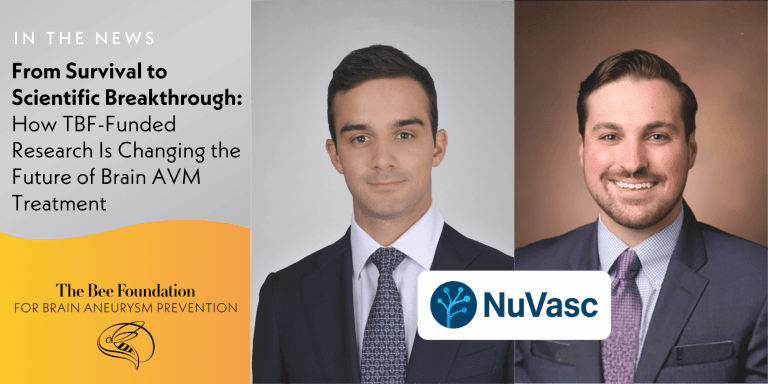
At the University of Alabama at Birmingham, a new startup is working to bring precision medicine to brain arteriovenous malformations (bAVMs). Behind it are two people whose lives have been shaped by The Bee Foundation: Dr. Andrew T. Hale, a two-time TBF grant recipient, and Zac Yezzi, a former TBF ambassador who now sits on our Board of Directors — NuVasc’s two co-founders.
A Survivor Who Refused to Just Move On
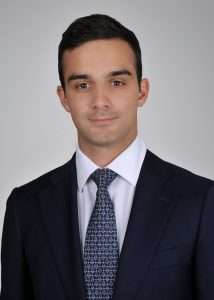
In 2021, Zac Yezzi survived a ruptured brain arteriovenous malformation and aneurysm. Multiple cranial surgeries followed, and then a long, grinding recovery.
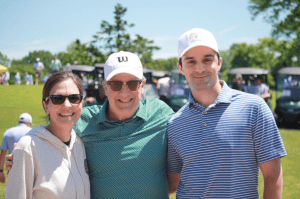 Most people, understandably, would want to put an experience like that behind them. Zac did the opposite. He got involved with The Bee Foundation as an ambassador, then joined our board, pushing us to fund research into brain aneurysms and other cerebrovascular conditions. He wanted future patients to have options he never had. That decision is part of why this story exists at all.
The Scientist Behind the Breakthrough
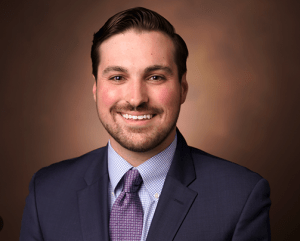
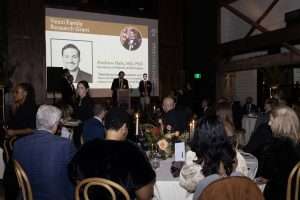
Dr. Andrew Hale has spent years at the University of Alabama at Birmingham studying the genetic drivers of brain AVMs. TBF has funded his work twice, and in 2025 he became the first-ever recipient of our inaugural Preventative AVM Grant — a program championed by Zac Yezzi and built specifically to push preventative research beyond brain aneurysms and into other cerebrovascular disease. His winning project, “Molecular Diagnostics for Personalized Pharmacotherapy in Brain Arteriovenous Malformations,” is what earned him that distinction.
Working with Dr. Kristopher T. Kahle at Massachusetts General Hospital, Hale’s team developed a liquid biopsy that can detect the genetic mutations driving an individual patient’s brain AVM. It’s the kind of early-stage, high-risk science that’s hard to fund anywhere else, which is exactly why TBF exists.
Why the Genetics Actually Matter
Here’s the part that made me sit up when I first heard it: roughly three-quarters of sporadic brain AVMs are driven by mutations in the KRAS or BRAF genes — the same pathways that have already reshaped cancer treatment.
Hale’s team found a way to test for those mutations using DNA collected during the same minimally invasive procedures already used to diagnose and treat AVMs. No extra surgery, no separate biopsy. Just a different question asked of a sample that was already being taken.
That changes what’s possible. Instead of treating every AVM the same way because it looks similar on imaging, doctors could eventually know what’s actually driving a specific patient’s lesion, and treat it accordingly.
“A genetic diagnosis is what unlocks targeted treatment,” Hale says.
Targeted treatments for brain AVMs barely exist today. This is a first step toward changing that.
From Grant to Company
The technology Hale and Kahle developed was patented through UAB and Massachusetts General Hospital, then exclusively licensed to NuVasc — the startup co-founded by Hale and Yezzi. NuVasc is now working with its academic partners to validate the diagnostic and move it toward clinical use, with the goal of eventually connecting a genetic diagnosis directly to a targeted therapy.
Zac put it simply: “As a brain AVM hemorrhage survivor, this is exactly the innovative solution I wish had been available to me.”
That line has stuck with me since I first read it. It’s the reason a foundation like ours funds unglamorous, early-stage lab work, because you never know which experiment turns into the thing a survivor needed and didn’t have.
Why We Fund Research Like This
A grant from The Bee Foundation is never just a check. It’s a bet that a scientist’s question is worth pursuing before anyone can prove it will pay off.
Dr. Hale’s work is what that bet looks like when it pays off: a research question that became a diagnostic technology, backed by a survivor who turned his own recovery into advocacy, that together produced a company trying to bring precision medicine to a disease that badly needs it.
NuVasc is still early. There’s a lot of work between where they are now and a treatment that reaches patients. That’s true of almost every scientific breakthrough at this stage. But every treatment we take for granted today started exactly where this is starting: with a grant, a question, and someone willing to keep going.
We’re proud to have funded Dr. Hale twice, and prouder still that Zac chose to turn his survival into a seat on our Board and, now, a company he co-founded with Dr. Hale to help the next patient who hears the words “you have a brain AVM.”
This is why The Bee Foundation exists, and it’s why we’re not done funding research like this.
Congratulations, Dr. Andrew Hale and Zac Yezzi. Your drive, passion, and commitment to changing the future of cerebrovascular conditions is encouraging to witness. We are beyond proud to stand beside you.
Written By TBF Director of Development & Donor Relations : Alyssa Giacomin