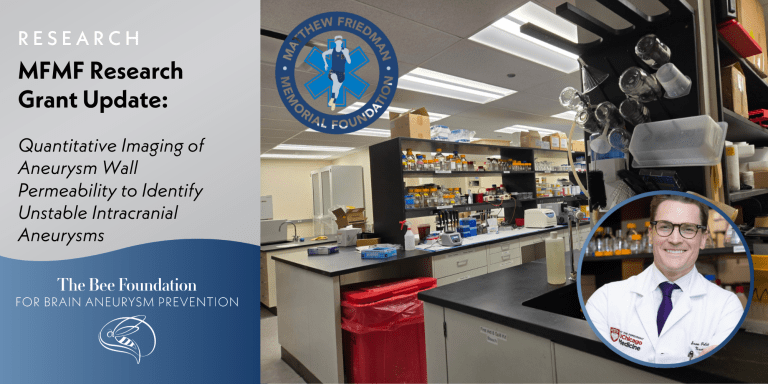
We’re excited to share a mid-year update from Dr. Sean Polster, recipient of The Bee Foundation’s 2025 Matthew Friedman Memorial Foundation Preventative Brain Aneurysm Research Grant.
Dr. Polster and his team at The University of Chicago are making excellent progress on their research project, “Quantitative Imaging of Aneurysm Wall Permeability Using Ktrans to Identify Unstable Intracranial Aneurysms.”
Dr. Polster is a cerebrovascular and skull base neurosurgeon dedicated to improving how brain aneurysms are detected before they become dangerous. His team’s research focuses on developing advanced MRI techniques that can safely and non-invasively identify aneurysms that may be at higher risk of rupturing. By better understanding which aneurysms are most likely to become unstable, physicians may one day be able to make more informed, personalized treatment decisions, and prevent ruptures before they happen.
To learn more about Dr. Polster’s research, read our original grant announcement: https://thebeefoundation.org/announcing-preventative-research-grant-recipient-dr-sean-polster/
Mid-Year Progress
We’re pleased to report that the project is on schedule and has already reached several exciting milestones:
- Advanced MRI technology is now fully operational. The research team can now use specialized imaging to measure subtle changes in aneurysm walls that may help identify aneurysms becoming unstable.
- Patient enrollment is underway. Participants are now joining the study, allowing researchers to build an important dataset that will deepen our understanding of how aneurysms change over time.
- A major proof of concept has been achieved. The team has successfully demonstrated that living cells can be safely collected during routine aneurysm procedures. This breakthrough opens the door to studying the biology of brain aneurysms in entirely new ways and confirms that this innovative approach is feasible.
- Researchers are identifying potential new biomarkers. By combining advanced vessel wall imaging with biological analyses, the team is searching for measurable signs that could one day help physicians better predict aneurysm behavior and personalize treatment recommendations
Looking Ahead
Dr. Polster and his team are encouraged by the progress made during the first half of the project and are excited about what comes next.
As Dr. Polster shares:
“We greatly appreciate the support of The Bee Foundation in enabling this work. The project has successfully established key technical infrastructure and preliminary feasibility data that position the study for continued growth and future external funding. We will continue to provide updates regarding patient accrual, imaging analyses, and downstream biologic studies as the project progresses.”
Thank You
To our incredible community, thank you. Because of your generosity, researchers like Dr. Polster and his team are advancing new approaches that could transform how brain aneurysms are detected and treated. Every step forward brings us closer to a future where aneurysms can be identified earlier, treated more precisely, and ultimately prevented from rupturing. Your support is helping make that future possible.