Before April 2024 I was living a relatively healthy lifestyle with no major medical problems. I was a 37-year-old living a busy and vibrant life in New York City for the better part of 15 years. I’d say that before the aneurysm rupture, a sprained ankle was the worst of my health issues.
On April 23rd, 2024, that all changed.
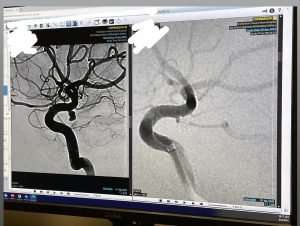 On that evening, I survived a subarachnoid hemorrhage – though I had no idea what it was at the time. It started like any other Tuesday evening at home, working on my laptop and eating takeout, when I was hit with a sudden, sharp pain in the back of my head, like something had snapped inside of my skull. To me it feels like the descriptive words “the worst headache of your life” which is what ruptured brain aneurysm headaches are most described as, aren’t quite strong enough to describe the feeling I had. The pain was intense, and it happened out of nowhere with no warning.
At the time, although I was fighting through disorienting dizziness, blurry vision, and nauseating pain, I assumed I was having my first migraine. Many of my friends have told me how terrible migraines are, and at the time I certainly was going through a VERY painful headache.
As the pain worsened and my neck stiffened, I started to get slightly worried. The thought of meningitis briefly crossed my mind, but I brushed it off, assuming that I must have had my neck in an awkward position while working on my laptop or perhaps had slept wrong the night before. I couldn’t imagine it being anything more than that. For what I told myself was simply for peace of mind, I finally went to a walk-in clinic the next morning.
At the walk-in clinic, I described my symptoms to the doctor there and I mentioned up front that I thought that I might be having my first migraine.
Unfortunately, they agreed with me – without running any tests.
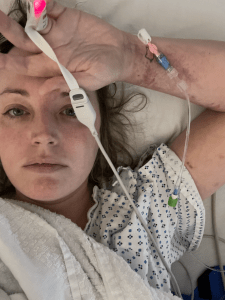 I was treated for a migraine which consisted of giving me a shot of an NSAID for pain and I was handed a few anti-nausea pills, then I was sent home. As I continued to get increasingly more ill throughout the day after this appointment I knew something wasn’t right.
 I called an Uber in the middle of the night around 1:45am on April 25th when I then headed to the ER at Mount Sinai Morningside in New York City approximately 36 hours after my searing headache pain began. I approached the Uber armed with an iPhone charger in case the ER was busy, a few magazines to read for if my vision and nausea improved, and a handful of other essential items assuming I’d be home in a few hours.
This assumption was incorrect. I was off by… days. Well, weeks.
The next time I came home was 18 days later, after enduring endovascular brain surgery done through my femoral artery, and after 15 days recovering in the Neuro ICU and 3 days in a step-down room at Mount Sinai.
Recovery was not easy. But it did kick off fast. At the time I am sure I was in survival mode. You really don’t know how much strength you have until you are tested physically, emotionally, mentally all at once and are able to come out on the other side.
 My recovery went exceptionally well. I know I am one of the lucky ones, and that is not lost on me. I believe the hardest part of my recovery was being patient with myself and giving myself time and space to recover. In my case, the mental/emotional recovery and physical recovery went hand in hand.
It’s easy to spot when someone has a cast on their broken arm. When someone is living with the aftermath of a brain aneurysm rupture, the brain fog and extreme fatigue, for example, are invisible and only apparent to perhaps only the survivor. Sometimes, that is helpful. Other times, it’s a bit of a barrier.