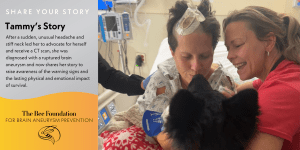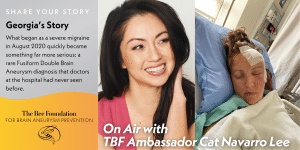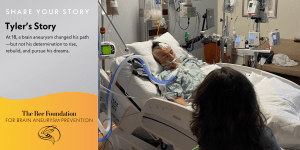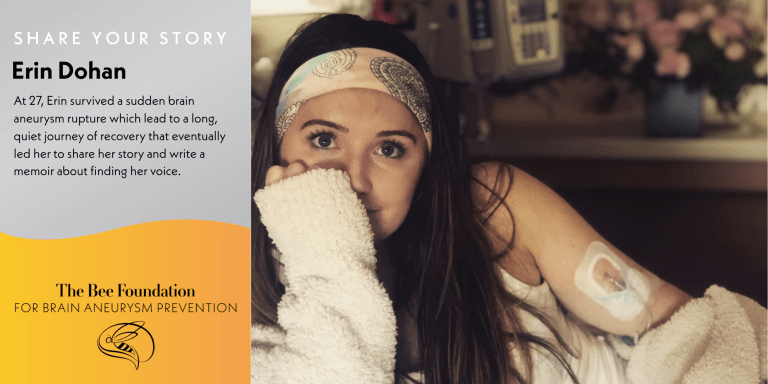
I was 27 years old, celebrating my third wedding anniversary, and recovering from an amazing Memorial Day weekend in Napa with friends when a brain aneurysm ruptured.
It was May 29, 2019. I was working from home in Oakland when I suddenly felt a big clap on the back of my head and what felt like liquid dripping down my neck. I put my hand to my neck, said “Well, that hurt” out loud to no one, and went back to work. I don’t know how long I kept working before the nausea hit. Powerful, rolling waves of it. I called my husband, Patrick, and managed to tell him something weird was happening. He thought food poisoning. I thought a strange delayed hangover from the long weekend. He told me to lie down and rest. So I did — on the bathroom floor. After I pulled my head out of the toilet, I curled up on the cold tile and took a nap.
The coldness felt soothing, and I couldn’t make enough sense of my surroundings to realize how strange a place the floor was for a nap when my bed was just a few steps away. When I woke up I had a handful of “happy anniversary” texts, missed calls from Patrick, and messages from work. I responded to all of them in what I thought was a normal manner. Patrick’s mom had texted us “happy anniversary” — Patrick replied “Thank you!” Hours later, in the same text chain, I responded “You’re welcome.” Patrick quickly explained to his mom that I was not feeling well. I went back to work with a puke bucket at my side. I started drafting a very detailed, color-coded, elaborately formatted response to a client’s yes-or-no question — full of broken formulas. Thankfully, I didn’t get the chance to hit send before the next wave of pain and nausea took over.
Patrick sensed something was really wrong and sent help. The paramedics found me lying on the bathroom floor as close to the toilet as I could get. They asked if I could walk out. I said yes. Patrick says they were carrying me. At the hospital, the staff knew exactly what tests to run. A dilated pupil and a turned-down smile triggered a quick response. I was rushed from the ambulance directly to a CT scan.
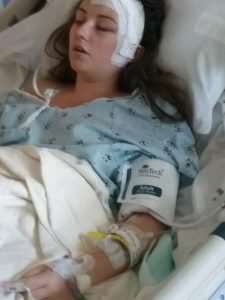 One of my last clear memories from that day is lying in an emergency room bed after my first of many CT scans and hearing a doctor say, “Brain bleed in bed 1H.” I knew bed 1H was me. I was still in my black pants and black-and-white striped shirt — I still own that shirt. Patrick had just arrived and was making his way to the side of my bed to grab my hand. I remember a lot of very small details about that moment, frozen in my head like a photograph. The calm before the storm. The diagnosis was a ruptured left choroidal aneurysm — a diffuse subarachnoid hemorrhage.
Once the doctor announced “brain bleed,” everything changed.
Everything suddenly felt so rushed, so urgent. I was told I’d be transferred to a hospital an hour away with a nationally renowned neuro ward. A helicopter was considered but an ambulance was faster. I was loaded up and driven through the Bay Area with a light glaring down through the back window that felt like it was burning through my retinas. A paramedic arranged my arms — around three IVs — so I could block the sun with my hands while he made small talk to keep me conscious. I forced myself to be polite, smile, joke back. I still wonder if I was making any sense.
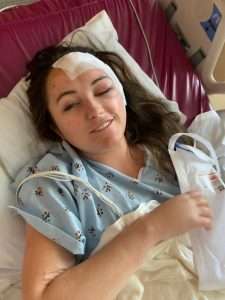
Then came the surgery — clip ligation to stop the bleed. Then angiograms. Then spasm checks. Then a long hospital stay. Then a longer recovery that I’m still not sure is over. For years after, I didn’t talk about it. Not really. I’d give people the short version and move on. I went back to work. Built a career in accounting and finance. Moved to Chicago with my husband, the man who sent the paramedics. Had a son. Life kept going and I kept not talking about it — not because I forgot, but because I didn’t know what to do with it.
 Then I started writing it all down. The rupture. The bathroom floor. The ambulance.
The silence that came after. Everything I’d been carrying quietly for years. That writing became a memoir called “I Think I’m Ready to Talk”, being published by Koehler Books. The title says it all. I spent a long time not being ready. And then one day I was.
I’m sharing my story with The Bee Foundation because I know how isolating this experience can be. When I was going through it, I would have given anything to find someone who understood what it felt like to be 27 and suddenly fragile in a way nobody around you can see. The first thing I noticed when I found TBF was that Jenny Sedney was 27 too. That hit me. I’m here and she’s not, and the only difference is luck and timing. That’s not something I take lightly. If you’re reading this and you’re the person I was looking for back then — scared, recovering, or just trying to figure out how to talk about what happened — I see you. I wrote an entire book for you.