An Unexpected Valentines Day: Rene’s Story
It started out a normal Valentine’s Day in 2022. As I arrived to work that day, I was feeling really good and excited about plans for a dinner with my partner. Two weeks prior, I did notice a weird headache at the right side of the base of my skull. I never had a history of headaches, so it seemed odd, but I chalked it up to stress and fatigue. On that particular day, I felt no headache at all. I was too busy to worry about a headache as I had recently started working at a new clinic as a chiropractor, while I continued to work in an orthopedic practice assisting in surgery. I was working 50 plus hours a week. To top it off, I cared for my elderly mother a few nights a week. While attempting to balance my time, I started to really stress out. I feel that this led me to turn off the warning signals my body was giving me. I just kept pushing through. I was 10 minutes into my third client of the day when I felt the most excruciating headache. My ears started to ring loudly, and with every move of my body, the headache worsened. The best way to describe it is like a pressure cooker steaming in my head. I remember that I had learned in my training that the worst headache of your life is a medical emergency. I excused myself and asked my assistant to call 911. There was a split second where I thought I would play through the pain and just take some Advil and lay down for a bit. Thank goodness I resisted that urge and took action!
I was transported to a local hospital via ambulance, where they started to work me up for a migraine and elevated blood pressure. I was very persistent with the ER doctor that this was not a “normal” headache. He ordered a CT scan and then a CT angiogram, and I was wheeled back to the emergency department. By that time, I was vomiting violently and sensitive to all the bright lights surrounding me. When he said the words “aneurysm” to me, I was in total shock. My grandmother had an aneurysm in 1992 and was brain dead instantly. My Aunt Rose also had an aneurysm in 2010 and survived after the coiling procedure. She gave me hope. I was terrified but hopeful. I was still able to talk and communicate a bit on the phone and text with my loved ones, but my speech was slurred and my vision blurry. Unfortunately, this happened during a COVID spike, so I could not see my partner, who was out waiting in the parking lot. I had to tell my loved ones about my aneurysm over the phone. It was scary and emotional, to say the least, given my family’s history, and I know they were all worried beyond belief. I was so determined to stay awake. Something kept telling me to stay awake and aware, I would not surrender to this aneurysm. I kept reminding myself of my resilient Aunt Rose. If she could do it, I could do it too!
About eight long and painful hours later, I was transferred to the hospital that would be performing the surgery. I spoke to the surgeon, who briefly explained the endovascular coiling procedure to me. I consented and was off to surgery. I made five short video calls with my loved ones. I knew they were all terrified, and I wanted to tell them how much I loved them before the procedure. I felt they would be comforted by the calls, and I tried my hardest to sound normal. These conversations were the hardest of my life. Afterward, I said a quick prayer, and, for the first time all day, I allowed myself to surrender.
At around 3 am on February 15, I recall waking up and feeling giddy, because I felt GREAT! I wasn’t feeling the crushing headache, that had tortured me all the previous day. I immediately placed a video call to my partner, Mel. She was shocked and surprised to see my face, as the surgeon told her she would likely not hear from me until much later in the day. When I think about this now, I know that the medications from surgery had something to do with my giddiness. Nevertheless, I was so happy to be headache free.
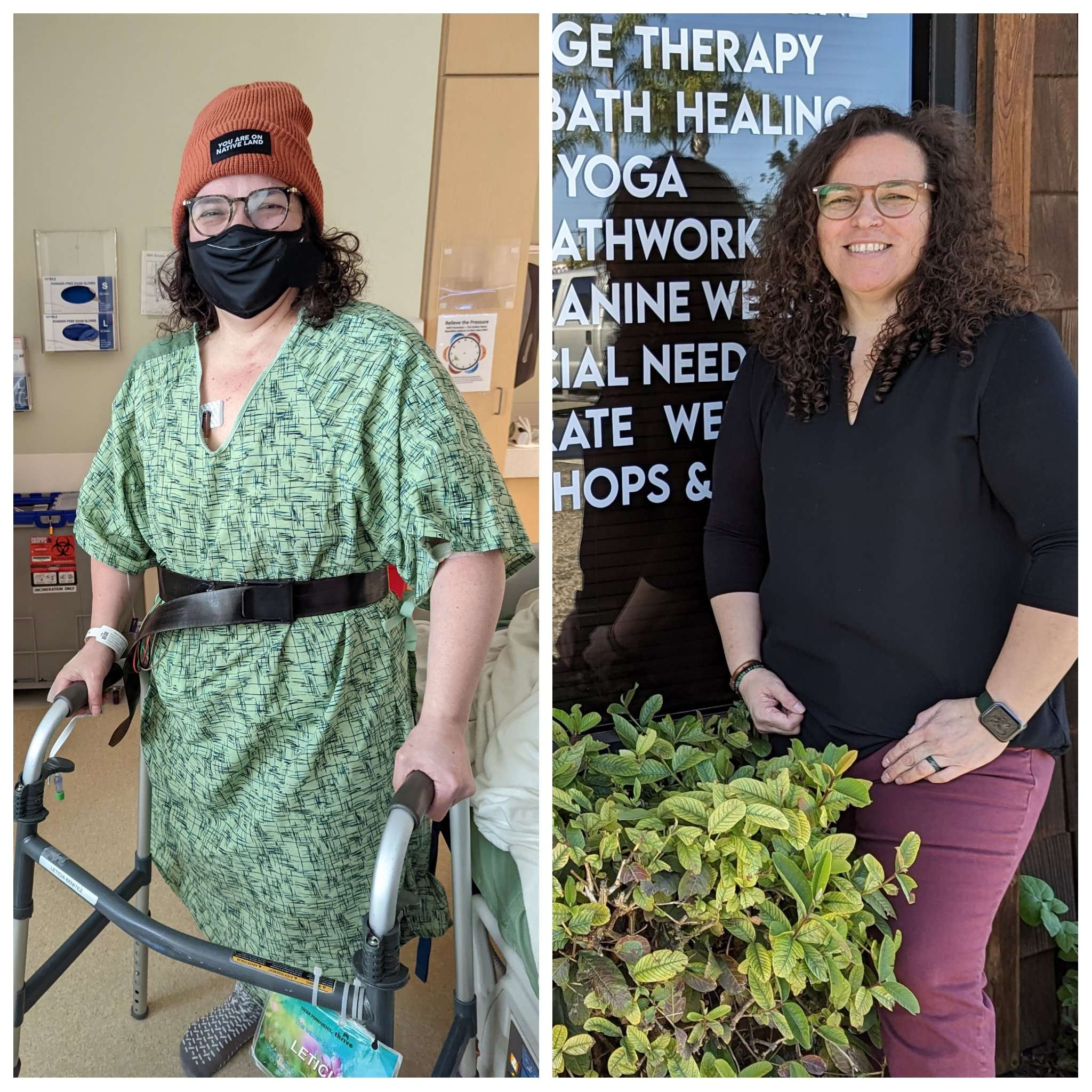 Later that morning, a swarm of doctors came in and out of my room in the Neuro ICU. They all seemed very happy and excited about the outcome of my procedure. All night, I was woken up and tested with manual neuro exams. All were normal. Not one single deficit was noted. I was taken down for a scan and was happy to hear that there were no longer any signs of blood in my brain and no signs of any brain damage. Just the coil in my basilar artery, doing its job. I was a little sore, but overall no signs of a headache! The next morning, I walked around the floor with the physical therapist and was able to eat my first meal sitting in a chair.
I spent the following 12 days in the ICU on something called “vasospasm watch,” and still no visitors allowed due to COVID. I had some good days and bad days. During that time alone, I was forced to process so many emotions. I went from fear to anger, to joy, and back again. I also felt this immense feeling of disbelief. How could this happen to me? I am a healthcare provider, and I should have known better. The PTSD was setting in. I blamed myself for not recognizing that I was under an extreme amount of stress, I wasn’t monitoring my blood pressure, and that the pre-cursor headache, what I now know is called a “Sentinel Headache,” was a clear sign that I just shrugged off. My body was telling me something was wrong, but I didn’t want to see it. I was too wrapped up in the hustle of my everyday life. I had disconnected myself from all internal warning signals, like unplugging an alarm going off because it is inconvenient. Hindsight is always 20/20. On a more physical note, the whole time I was in the ICU I was also experiencing severe low back pain with sciatic nerve pain into my right leg. This is a common issue after ruptured brain aneurysms due to the blood leaving the brain and traveling into the spinal canal. The blood becomes an irritant and can cause nerve irritation. This made walking, sitting and even lying in bed difficult. I did my best to move as much as possible with physical therapy, but this pain also required medication for management.
After coming home, I spent so much time reconnecting with my body. I also worked on forgiving myself. I realized that this could happen to anyone, as we are all so focused on our daily tasks, we sometimes forget about our self-care and we disconnect from our bodies. I spent a lot of time meditating, using stress-reducing breathwork and yoga, to rehabilitate. I cried a lot and allowed myself to feel all the different emotions. I had an amazing support system, including my partner, family, friends, and an incredible somatic psychotherapist. Now, I feel so much gratitude for the second chance I have been given.
After my experience, I have spent the last year developing and creating a Community Wellness Center focused on stress reduction, and connection utilizing meditation, breathwork, yoga, massage, chiropractic, and other stress-reducing holistic modalities. I now use my position as a healthcare provider to advocate for early screening and overall awareness of brain aneurysms and AVM.
It is coming up on the 1-year anniversary of my brain aneurysm, and I wanted to share my story for awareness, as well as to assist in other’s as they go through recovery. It is my hope that sharing this story will help to educate others about the early warning signs of brain aneurysms and AVM. Awareness is essential and key to early treatment, which leads to higher survival rates. The most common question I get asked is how the symptoms presented. Again, I hope my story will help someone see the signs and act.