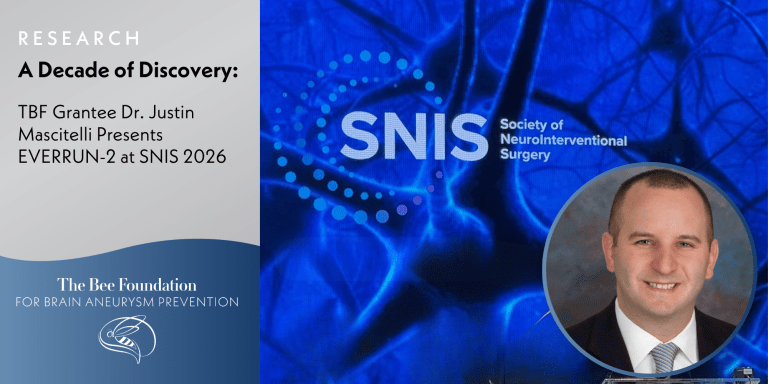
Nearly ten years after receiving his TBF grant, Dr. Justin Mascitelli stood before a room of the field’s leading neurosurgeons at the 23rd Annual SNIS Conference and challenged one of its most settled assumptions: that the newer, less invasive treatment is always the better choice for a ruptured brain aneurysm. His talk, “Endovascular Therapy Versus Microsurgical Clipping of Ruptured Wide-Neck Aneurysms (EVERRUN-2),” showed that for one especially tricky type of aneurysm, that isn’t necessarily true.
Dr. Mascitelli, of UT Health San Antonio, received a TBF Preventative Research Grant in 2017. At the SNIS Meeting in Seattle, WA, he presented his findings to fellow neurosurgeons, physicians, and researchers, with TBF team members Erin Kreszl, Christine Kondra, Meg Fell, and Laura Geib watching from the audience.
The Research
When someone has a brain aneurysm rupture, doctors have two main ways to fix it. One is a minimally invasive procedure called endovascular therapy, where a doctor threads a thin tube through the blood vessels and fills the aneurysm with tiny coils to seal it off from the inside. The other is microsurgical clipping, an open surgery where a doctor places a small metal clip across the base of the aneurysm to close it off completely.
About 20 years ago, major studies found that patients tended to do better with the coiling procedure, and the medical field shifted hard in that direction. Today, coiling is used far more often than open surgery, partly because it’s easier on the patient and easier to schedule.
But Dr. Mascitelli noticed something: those studies didn’t look closely at “wide-neck” aneurysms, ones with a broad base that makes it hard for coils to stay in place. Treating these often requires extra equipment and blood-thinning medication, which can be risky for someone who just had a bleed in their brain. So he asked a simple but important question: is coiling really the better option for these specific, harder-to-treat aneurysms?
To find out, Dr. Mascitelli and a team of researchers from seven hospitals across the country tracked 301 patients who had ruptured wide-neck aneurysms. Some were treated with coiling, others with open surgery, and the team followed each patient for a full year afterward.
Here’s what they found:
- Patients recovered equally well either way. About 3 out of 4 patients had a good recovery after one year, regardless of which treatment they received.
- But coiling was far more likely to need a “do-over.” More than a third of patients who had coiling needed a second procedure because the aneurysm hadn’t fully closed. Among patients who had open surgery, none needed a repeat procedure.
In other words: both treatments gave patients a similar shot at recovery, but open surgery was much more likely to fix the problem for good on the first try.
Why it matters
This research pushes back on the idea that the newer, less invasive treatment is automatically the best choice for every patient. For wide-neck aneurysms specifically, open surgery may actually be the safer long-term bet, sparing patients a second, riskier procedure down the road. It’s the kind of finding that could quietly reshape how surgeons make one of the most important decisions a patient will ever face.
That’s what a decade of TBF funding makes possible. Thank you, Dr. Mascitelli, for your relentless commitment to advancing brain aneurysm care.
Read his original research update here!