Rita Skertich’s Legacy
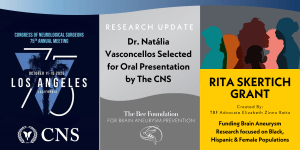
What began as one person’s story became a force for change. The TBF Rita Skertich Health Equity Grant is a powerful example of how personal experience can inspire progress that impacts thousands of lives.
The grant was created by TBF Ambassador Elizabeth Ratta to honor her grandmother, Rita Skertich. In the 1970s, Rita had an unruptured brain aneurysm at a time when the condition was poorly understood and treatment options were extremely limited. Motivated to pay it forward, Elizabeth established this grant to drive research focused on the populations most affected by brain aneurysms, women and Black and Hispanic communities, where disparities in diagnosis, treatment, and outcomes remain significant.
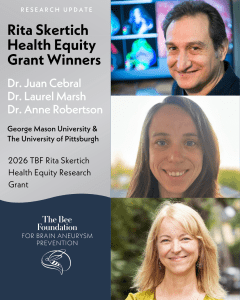
Meet the 2026 Grant Recipients
We are proud to recognize the Second Annual Rita Skertich Grant recipients: Dr. Juan Cebral, Dr. Laurel Marsh, and Dr. Anne Robertson from George Mason University and the University of Pittsburgh!
Their project, “Identifying Modifiable and Non-Modifiable Conditions Associated with Increased Aneurysm Rupture Risk in the Black, Hispanic, and Female Sub-Populations” tackles one of the most urgent questions in cerebrovascular health:
Why are some brain aneurysms more likely to rupture, and why does that risk differ across populations?
The team is analyzing, in new ways, more than a decade of patient information gathered with support from the NIH, and now focusing on two key categories of risk factors:
- Modifiable Risk Factors: smoking, blood pressure, medications, lifestyle habits, etc.
- Non-modifiable Risk Factors: age, sex, genetics, race, ethnicity, etc.
By studying how these factors interact, researchers hope to identify which risks matter most, and for whom. What makes this study especially groundbreaking is the depth and diversity of its data. The team is analyzing more than a decade of patient information, including:
- Medical and dental records
- Imaging scans
- Blood, saliva, and tissue samples
- Surgical videos
- Advanced 3D simulations of blood flow in each patient’s aneurysm
This comprehensive dataset spans multiple institutions, including Allegheny General Hospital, UIC Chicago, Northwell Hospital in Long Island, Cleveland Clinic, UHC, as well as international participants across Europe and Argentina.
The Potential Impact
The ultimate goal of this research is not just understanding, but action. If the team can pinpoint the most important risk factors: then Physicians can better predict which patients are at highest risk of rupture, treatments can be tailored to specific populations, and patients can take proactive steps to reduce their risk. In short, this work has the potential to move us closer to personalized, equitable care in brain aneurysm treatment.
Looking Ahead
Rita Skertich’s story is a reminder of how far we have come, and how far we still need to go. Through this grant, with the drive of her granddaughter, Elizabeth, her legacy lives on in research that prioritizes unchartered research in both health equity and prevention.
Congratulations to Dr. Cebral and team! We are honored to support this groundbreaking work and excited to see the impact it will have on the future of brain health.