At TBF, we believe in a future where prevention prevails. We are confident that one day we will be able to identify aneurysms before they rupture and stop the devastation they cause. This conviction drives us to fund life-saving, groundbreaking research dedicated exclusively to brain aneurysm prevention. Below you’ll find updates on two of our 2024 Research Grant Recipients and the important work they are advancing toward that future.
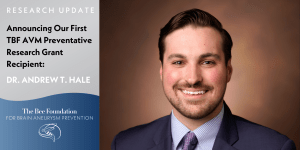
Dr. Andrew Hale
In 2024, Dr. Andrew Hale received the 2024 TBF Preventative Research Grant in Honor of The Yezzi Family. Dr. Hale, from the University of Alabama at Birmingham, is trying to “Identify somatic mutations and transcriptional pathways in cerebral aneurysms using endoluminal biopsy.”
Read Dr. Andrew Hale’s research update:
The goal of my 2024 TBF Preventative Research Award is to better understand the genes that cause brain aneurysms. We now know that many different genes—not just one—play a role. Large genetic studies, including some from my own team, have shown that changes in the parts of DNA that control how genes turn on and off may increase the risk that an aneurysm will burst.
Previous research has found a few rare genetic mutations linked to aneurysms, but most cases still don’t have a clear genetic explanation. One big challenge is that we almost never get access to the actual aneurysm tissue while it’s still inside the body, which is where the most important genetic clues live.
To solve this, we have begun using a new technique where, during a standard minimally-invasive aneurysm procedure (coiling), we collect tiny samples of the aneurysm from inside the blood vessel. This is called endoluminal tissue sampling (ETS). We’ve now created a reliable process for collecting these samples and have successfully gathered about 10 biopsies. These early successes have helped us launch a new 2025 TBF project that uses this same sampling method—along with a custom-built genetic testing platform—to study brain arteriovenous malformations (bAVMs). About half of these malformations have genetic mutations that could potentially be treated with existing drugs.
Overall, this work is laying the foundation for a future where we can diagnose brain vessel diseases using small samples or even blood tests—and eventually use personalized, gene-targeted treatments or gene-editing therapies to prevent ruptures before they ever happen.Dr. Andrew Hale

Dr. Hale, thank you for the important work you are doing. We are excited to learn of the results when the research is complete and wish you luck with your 2026 project!
Watch Dr. Hale’s testimonial here
Dr. Rosalind Lai
Dr. Rosalind Lai is the recipient of the 2024 TBF Preventative Research Grant in Honor of Brittany McCarthy. From the University of Buffalo, Dr. Lai is “investigating the role of X chromosomes in the development of cerebral aneurysms through the XO mouse model.”
Read a research update from Dr. Lai here:
Over the past year, Dr. Rosalind Lai’s team has successfully built and tested a new mouse model to better understand why brain aneurysms form — and why they rupture. They created aneurysms in both male and female mice and confirmed key differences that mirror what we see in humans: female mice showed more twisting of blood vessels and a higher chance of a dangerous brain bleed (subarachnoid hemorrhage).
By examining the blood vessels under a microscope, the team saw clear signs of what happens when an aneurysm is about to rupture: the inner lining of the vessel starts to break down, the muscular wall becomes thin, and the elastic layer that normally gives the vessel strength becomes damaged. These findings confirm that their model is working as intended.
Right now, about half of the mice develop aneurysms in this system. With guidance from a leading lab that achieves a 75–80% success rate, Dr. Lai’s team is refining the procedure to make the model even stronger and more reliable. Their updated research protocols were approved in October 2025, clearing the way to accelerate progress.
By December 2025, they expect to have their next round of male and female mice ready for study — and by spring 2026, they plan to introduce a new XXY genetic model that could offer groundbreaking insights into how sex chromosomes influence aneurysm risk. They anticipate having exciting early findings to share later that year.Dr. Rosalind Lai


Dr. Lai, thank you for your dedication to brain aneurysm research. We look forward to the completion of your work!
Advancing prevention is only made possible through the commitment of supporters who share our belief in a world free from the fear of aneurysms. To support our mission and help make prevention a reality, please consider donating to our 2026 TBF Preventative Research Grant Program: